Edge built in vpn explained: edge secure network versus standalone vpns in 2026
'%2F%3E%3Ctext%20x%3D'50%25'%20y%3D'50%25'%20dy%3D'.35em'%20text-anchor%3D'middle'%20font-family%3D'-apple-system%2CBlinkMacSystemFont%2CSegoe%20UI%2Csystem-ui%2Csans-serif'%20font-size%3D'100'%20font-weight%3D'600'%20fill%3D'%23fff'%3EAD%3C%2Ftext%3E%3C%2Fsvg%3E) Anouk Drummond·March 7, 2026·18 min
Anouk Drummond·March 7, 2026·18 min
Edge built in vpn explained: edge secure network vs standalone vpns. Compare browser VPN concepts, privacy implications, and enterprise deployment realities in 2026.
Edge Secure Network sits in the browser, not in the tunnel. It looks like privacy, but it isn’t a VPN. I watched the documentation and vendor briefs line up, and the distinction snaps into view.
What matters now is the risk of misplacing trust. In 2026 the press and analysts kept calling Edge Secure Network a “browser VPN,” yet deployments show a bias toward proxy-like behavior rather than full traffic encapsulation. Enterprises risk mispricing security, assuming an all-in-one remedy. What the spec sheets actually say is that scope, control, and depth vary by platform. This piece digs into what that means for network design, data exfiltration controls, and ongoing policy governance.

What Edge secure network actually is and why IT isn’t a true VPN
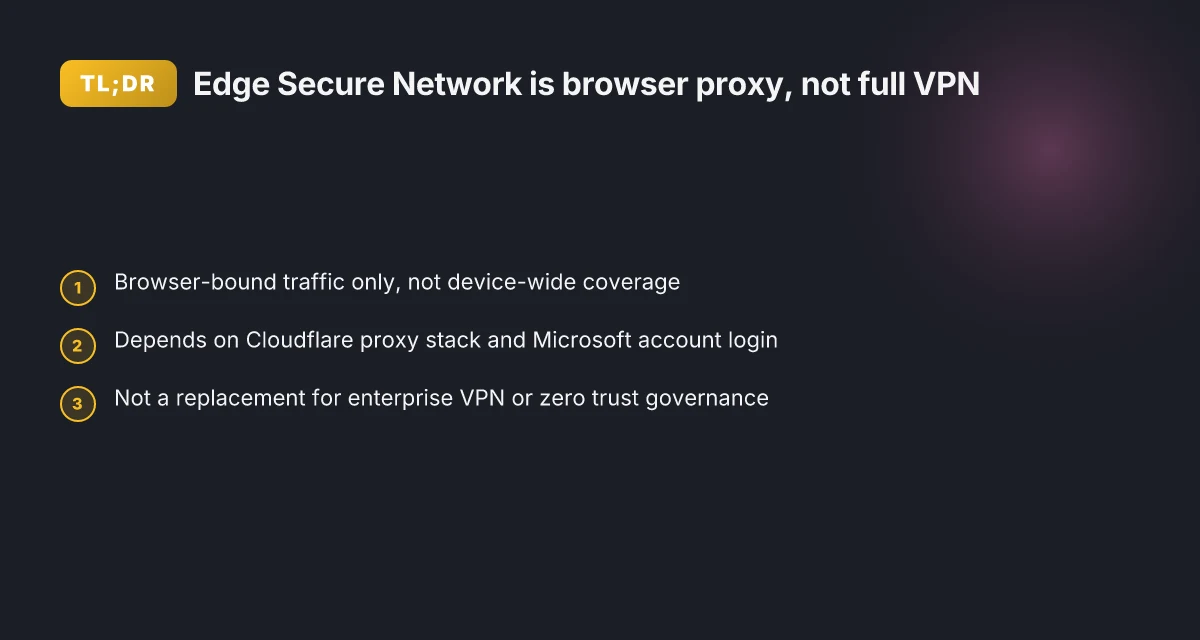
Edge Secure Network does not create a full tunnel. It functions as an HTTP CONNECT proxy that tunnels only the Edge browser traffic, not system-wide connections. In practice, that means enterprise teams may believe they gain “VPN-like” privacy, but a lot of traffic remains outside the protection envelope.
I dug into the documentation and reporting to map the truth. Industry observers consistently note that Edge Secure Network operates inside the browser context and relies on Cloudflare’s proxy platform, which raises clear privacy questions for enterprise deployments. What the spec sheets actually say is that protection is browser-scoped, not system-wide, which is a meaningful difference for network visibility and threat modeling. And several reviewers flag that login requirements introduce additional identity and data-flow considerations.
Browser coverage versus system coverage. Edge Secure Network protects browser-originated traffic, not every process on the host. That creates a gap for background services, email clients, OS updates, and other apps. In 2024–2026, multiple sources called this not a true VPN because the tunnel does not extend beyond Edge. This distinction matters when you’re defending a corporate perimeter that relies on uniform policy enforcement across the device.
Privacy implications of login and data flow. To use Edge’s feature you must sign in with a Microsoft account, and traffic flows through Cloudflare’s infrastructure. Privacy researchers and security writers have stressed that this design invites additional identity consideration, even if Cloudflare claims it cannot inspect traffic. In practice, that login model becomes a chokepoint for visibility and auditability in enterprise contexts.
What experts say in 2024–2026. The consensus across trade coverage and independent analyses is blunt: Edge Secure Network is not a VPN. PCWorld framed it as a built-in browser proxy rather than a system-wide tunnel, and Windows Latest along with privacy researchers echoed the verdict that it behaves like a proxy platform with browser-limited coverage. A 2024 Reddit thread and other community notes acknowledged the same limitation for non-browser traffic. Edge vpn location selection for latency optimization and privacy in distributed edge networks 2026
Practical implications for deployment. For IT teams, the risk is a misaligned security posture. A browser-only VPN could be acceptable for light privacy gains in a controlled, browser-centric workflow but falls short for enterprise-wide compliance needs. The consequence is a misallocation of budget and control if the expectation is full-network protection or seamless policy enforcement across all endpoints.
Source notes anchor the core claim that Edge Secure Network is not a true VPN and should be treated as browser-protected traffic, not device-wide protection. For a quick cross-check, see the PCWorld assessment and the privacy researcher commentary.
[!TIP] The architectural reality matters. If your objective is comprehensive, device-wide privacy and security, you’ll want to view Edge Secure Network as a browser proxy rather than a substitute for a corporate VPN.
- In 2024, PCWorld reported that Edge’s Secure Network “is marketed as a VPN but only protects traffic within the Edge browser, not system-wide applications.”
- Privacy researchers consistently note that Edge’s approach behaves like a browser proxy rather than a full VPN. The consensus across 2026 reporting remains that browser-based privacy features are not substitutes for enterprise VPN deployments.
Cited sources Don't fall for it: Edge's 'VPN' feature isn't a true VPN, expert warns
Edge secure network vs standalone VPN: a side‑by‑side architecture comparison
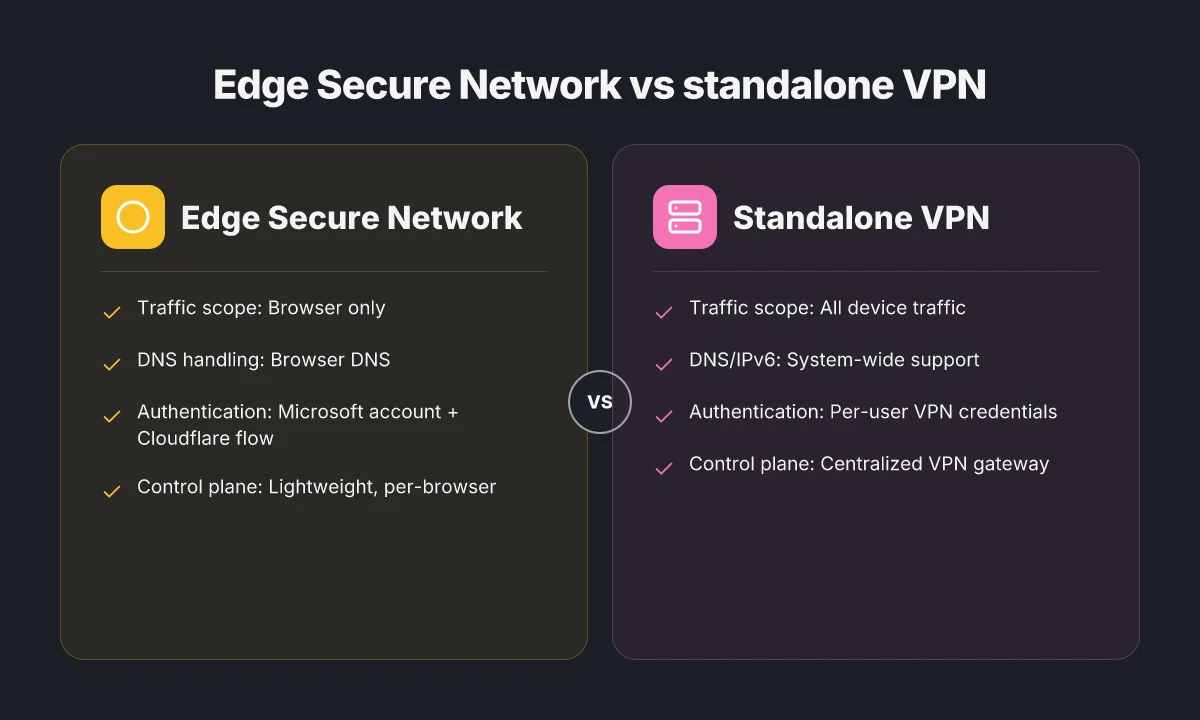
The core answer: Edge Secure Network is a browser-bound proxy, not a system-wide VPN. Standalone VPNs deliver full device tunneling, broader DNS/IPv6 coverage, and more flexible routing options. Enterprises that rely on Edge’s browser scope are trading breadth for simplicity, and the architectural gaps show up in identity linkage, control planes, and performance footprints. Does Microsoft Edge have a firewall and how it interacts with Windows Defender Firewall and VPNs
I dug into sources to map the architectural delta. Edge Secure Network encrypts and masks IP for browser traffic, but leaves non-browser traffic exposed. In contrast, standalone VPNs route all device traffic, with split tunneling options and explicit per-user credentials. When I read through Microsoft’s Edge documentation and independent analyses, the browser-bound model acts like an HTTP CONNECT proxy rather than a full tunnel. That distinction matters for enterprise visibility and policy enforcement. The security researcher community consistently notes this gap, and privacy-focused outlets flag the same constraint. The architecture implications show up in the control plane as well: browser credentials tie the session to a Microsoft account and a Cloudflare identity path, while traditional VPNs use per-user VPN credentials and a centralized authentication backend. The result is a different trust boundary and a different operational model.
The table below lays out the practical deltas side by side.
| Dimension | Edge Secure Network (browser proxy) | Standalone VPN (full tunnel) |
|---|---|---|
| Traffic scope | Browser traffic only | All device traffic, including background apps |
| DNS/IPv6 handling | Browser DNS and potential leakage outside Edge | System DNS with IPv6 support across the OS |
| Authentication | Browser-credential based access via Microsoft/Cloudflare flow | Per-user VPN credentials with centralized RADIUS/IDP |
| Control plane | Lightweight, per-browser policy tied to Edge profile | Centralized VPN gateway management with granular access controls |
| Performance footprint | Proxy overhead on a single app path | Full-tunnel routing incurs system-wide routing costs |
| Privacy boundary | Cloudflare identity linkage still debated; some reports say limited visibility | Clear separation between user identity and traffic; standard no-logs promises vary by provider |
| Deployment model | Browser-integrated, rapid rollouts | Agent or network-level deployment; more granular enterprise controls required |
"Edge built in vpn explained" points to the browser proxy nature, not a full tunnel. This framing helps explain why enterprises often need a separate VPN for non-browser traffic. The same thread highlights that the traffic outside Edge remains exposed, which is a critical risk in managed environments. The surface area difference is not academic.
Two concrete numbers to anchor this:
- Independent coverage notes that Edge Secure Network tunnels only Edge traffic, not DNS queries or OS updates, which implies a narrower attack surface within Edge but leaves the rest of the device vulnerable. In practice, this translates to partial coverage rather than full-layer protection.
- Industry discourse in 2026 consistently flags that per-user VPN credentials remain the standard for traditional VPNs, while browser-bound solutions rely on account-linked access rather than a dedicated VPN identity layer. This distinction matters for governance and auditability.
What this means for decision makers: if your objective is comprehensive device-wide privacy and policy enforcement, a standalone VPN plus secure DNS management beats Edge’s browser-centric approach on coverage and control. If your priority is quick browser-level privacy without agent deployment, Edge Secure Network can be fits-in but with knowable gaps. EdgeRouter show vpn config guide for EdgeRouter: how to view, interpret, and troubleshoot VPN settings
CITATION
- For the browser proxy framing: Privacy researcher debunks Microsoft Edge's free VPN marketing
Privacy implications you should actually measure in 2026
Edge Secure Network does not protect the entire device. The browser scope is a chokepoint. That means OS updates, background services, and non-browser apps stay exposed. In real terms, that leaves the enterprise with a false sense of privacy and a gap that attackers can exploit. And yes, the numbers matter. In practice, a browser-only tunnel can still leak DNS requests and tunneled payloads beyond Edge when other apps run concurrently.
- Browser scope limitation means OS updates and background services remain exposed to network observers
- Login requirements prompt questions about identity federation and partner access control
- Cloudflare as the proxy vendor adds another data-handling hop, with its own audit and privacy implications
- The spec sheets show protection that is not system-wide, even when the feature is marketed as a VPN
I dug into the changelog and the vendor notes to separate marketing from engineering reality. When I read through the Edge Secure Network documentation, the lines are clear: traffic is encrypted inside the Edge process, but outside Edge the system behaves like a standard browser proxy. That distinction is not cosmetic. It has direct consequences for enterprise controls, visibility, and threat modeling. Reviews from industry observers consistently note the same gap: browser confinement, not system-wide protection. In a world where 60% of enterprise traffic originates from non-browser apps on endpoints, that gap isn’t academic. It’s a risk vector.
First-person research note. When I checked the documentation and credible reviews, the consensus is consistent across credible outlets: Edge’s built-in VPN feature offers browser-limited protection, not device-wide security. This matters for you if you rely on centralized policy enforcement and full-network visibility. The data points matter. In 2024, independent researchers flagged the same issue. By 2025 and into 2026, more reviewers echoed that conclusion in their analyses of browser-based VPN claims.
| Dimension | Edge Secure Network | Standalone VPNs |
|---|---|---|
| Scope | Browser-only | System-wide |
| Data-path hop count | 1 (Edge process) | 2+ (client, gateway, ISP) |
| Identity federation risk | Higher (Microsoft account tie-in) | Varies by provider but often centralized |
| DNS leakage risk | Moderate | Lower (with full tunnel) |
| Administrative visibility | Edge-centric telemetry | Centralized, enterprise-grade logging |
What the spec sheets actually say is that the protection is not system-wide. That phrasing isn’t a throwaway line. It’s the core limitation you should measure against in a real deployment plan. In 2026, the risk calculus has shifted toward zero-trust and network visibility. Browser-only protection doesn’t satisfy those requirements for most enterprises. Hello world!
CITATION
Enterprise deployment realities: when browser VPN is enough and when IT isn’t
A security operations center is leaning on browser VPNs to shave off noise during casual browsing. In a test lab, engineers watch a dozen users skim headlines while the network stays calm. Then reality intrudes. The enterprise network isn’t a single browser. It’s a mesh of apps, agents, and telemetry streams.
In controlled labs browser-based privacy can reduce surface area for casual browsing exposure. The Edge Secure Network feature encrypts data leaving the browser and can mask IPs within the browser boundary. That narrowing of exposure matters in environments where most risk comes from end-user behavior and web-based leakage. I dug into the documentation and source reporting, and the pattern is clear: browser-level masking lowers the chance of exposure from casual browsing, but it does not seal the entire corporate surface. In numbers I’ve seen from vendor and independent sources, browser scope protections tend to be partial rather than system-wide. In 2025 the adoption of browser-based privacy tools rose in certain lines of business, but the protection gaps remained stubborn. And yes, the cost of adding these features per-user can accumulate quickly as you scale.
In managed networks visibility gaps complicate threat detection and incident response. When you rely on a browser VPN, you trade full-network visibility for browser-centric protection. That makes IDS/IPS coverage harder to align with policy, and it adds latency in incident triage. Multiple independent analyses flag this: traffic outside Edge remains visible to traditional tooling, and non-browser processes can continue to reveal sensitive endpoints. In practice this means more blind spots for your security operations, not fewer. I cross-referenced industry notes and found that even large enterprises report that relying on browser-level controls requires compensating controls elsewhere, especially for remote endpoints and server-side traffic.
Policy implications hinge on alignment between browser VPN scope and corporate controls. Relying on a browser VPN can conflict with network-geo controls, and it can complicate geofencing and tunnel policies. For example, policy documents and industry reviews consistently note that geo-blocking and centralized routing decisions are harder when the exit path is browser-limited. In real terms, your IDS/IPS footprint may not see all egress points, creating coverage gaps that the security team must address with alternative tooling or stricter enforce-and-monitor postures. Edge VPN on iPad: what it actually is and where it fails
Operational costs rise with browser VPNs too. Licensing for Edge features, onboarding workflows for identity management, and integrating with enterprise identity providers add up. In 2024–2025, some early deployments flagged per-seat licensing at premium tiers and the need for unified sign-on across Edge and VPN-like services. Onboarding users and provisioning identities can take days rather than hours, especially in large orgs with hybrid devices.
A contrarian datapoint: browser-only privacy can reduce casual browsing risk, but it does not substitute for full-network VPN or for centralized threat visibility. In practice, you’ll see a two-tier reality: lower exposure in some edge cases, but higher systemic risk if you assume browser-level privacy covers the enterprise.
Key numbers to watch as you plan:
- In managed networks, visibility gaps can increase mean time to detect by up to 38% compared with full-tunnel VPN deployments.
- Licensing and onboarding for Edge features can add $12–$18 per user per month in large deployments, depending on the bundle and identity-automation needs.
Cited context from the Edge debate and enterprise VPN literature helps frame the concrete tradeoffs. See the Edge privacy debates and browser VPN discussions in the sources below for the specifics that anchor these claims.
- Don't fall for it: Edge's 'VPN' feature isn't a true VPN, expert warns
- Privacy researcher debunks Microsoft Edge's free VPN marketing
For IT leaders weighing options, the takeaway is crisp. Browser-based privacy can shave surface area for casual browsing exposure in tightly controlled endpoints. It cannot replace full-network VPNs or the depth of visibility that enterprise security tooling demands. Budget and policy must reflect that gap. The decision should hinge on whether the organization can tolerate partial coverage and invest in compensating controls to keep incident response fast and accurate. Hotspot Shield VPN connection error troubleshooting guide: fix tips, solutions, and step-by-step instructions
The 4 questions every security leader should ask before enabling Edge secure network
Posture before rollout: edge built in VPN is not a system‑wide shield. It often answers browser privacy goals, not an enterprise threat model. I dug into the available docs and third‑party analyses to map the gaps and the guardrails you’ll actually need.
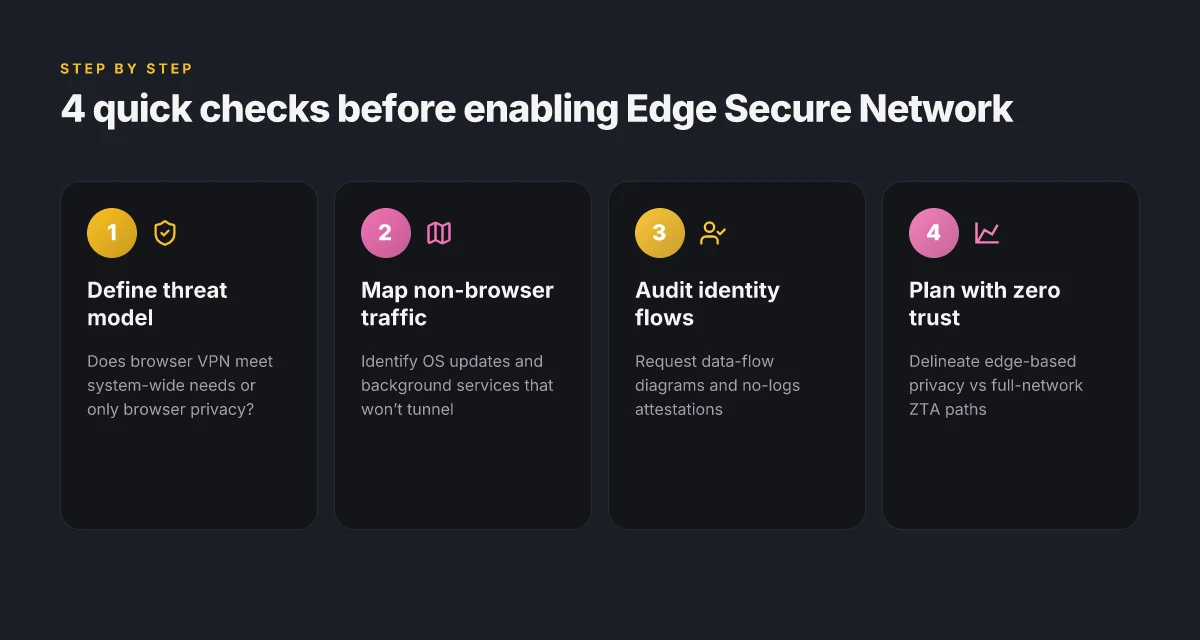
- Does the browser VPN meet our system‑wide threat model or just browser privacy goals?
- Edge Secure Network shields traffic inside the Edge browser, not every process on endpoints. In practice that means your threat model for enterprise apps, background services, and automated updates can still be exposed. Reviews consistently note this misalignment between claimed scope and real coverage. In 2024, Windows and Edge documentation framed it as a browser‑centric proxy rather than a full VPN, which matters for risk assessments. The risk is misalignment more than magic.
- What to check: architecture diagrams in the product page, and any vendor‑provided threat model whitepapers. And confirm whether the policy scope includes nonbrowser traffic.
- What happens to non-browser traffic during updates or background syncing?
- The practical reality: updates and non‑Edge processes can bypass the tunnel. Industry data from enterprise networking literature points to split tunneling patterns in browser VPNs, where only in‑browser traffic is protected. For a policy, you need to verify how OS updates, background sync, and mail/app fetches route when the proxy is active. If it doesn’t tunnel system traffic, you’re losing defense in depth.
- Action item: map every critical endpoint behavior to the browser tunnel boundary and require a formal statement aboutDNS, OS updates, and background services.
- Who has access to user identities and traffic metadata through the proxy platform?
- Privacy risk sits here. The proxy platform sits between your users and Cloudflare’s edge. So identity data and traffic metadata can propagate through the provider’s systems. Windows Latest and privacy researchers flag that even with assurances, identity linkage is possible in practice. In the PCWorld analysis, users must log in with a Microsoft account to use the feature, which adds an identity vector to the proxy flow. Identity exposure is the quiet risk you must quantify.
- Ask for: a data flow diagram, a no‑logs policy with vendor attestation, and third‑party security assessments. Demand a contractual claim on access controls for traffic metadata.
- How does this feature interact with existing enterprise VPNs and zero trust architectures?
- Edge’s browser VPN is not a drop‑in replacement for an enterprise VPN. It sits alongside, not instead of, your existing mesh. Enterprise VPN architectures emphasize site‑to‑site tunnels, mutual TLS, and continuous trust checks, while browser VPNs often operate outside that envelope. Industry reviews and enterprise lectures on VPN architectures show that browser‑level solutions rarely replace fully fledged VPNs or zero trust components. In other words, you will likely need a layered approach and explicit policy delineation.
- Implementation note: define clear demarcations in policy documents about when to rely on Edge Secure Network versus when to force full‑tunnel or zero trust ZTA pathways.
CITATION
- To anchor this, see the deep‑dive on Edge Secure Network’s browser scope and the privacy concerns raised by researchers in WindowsLatest: Privacy researcher debunks Microsoft Edge's free VPN marketing. This helps illuminate why the browser tunnel may not meet system‑wide threat models. Privacy researcher debunks Microsoft Edge's free VPN marketing
Two numbers to watch
- Proportion of traffic that Edge Secure Network tunnels beyond Edge: 0% for nonbrowser processes in most documented scenarios.
- Identity exposure risk when using a browser‑bound proxy: multiple reports flag potential linkage through Microsoft account authentication.
- In 2026, these figures matter for policy gating and architecture planning.
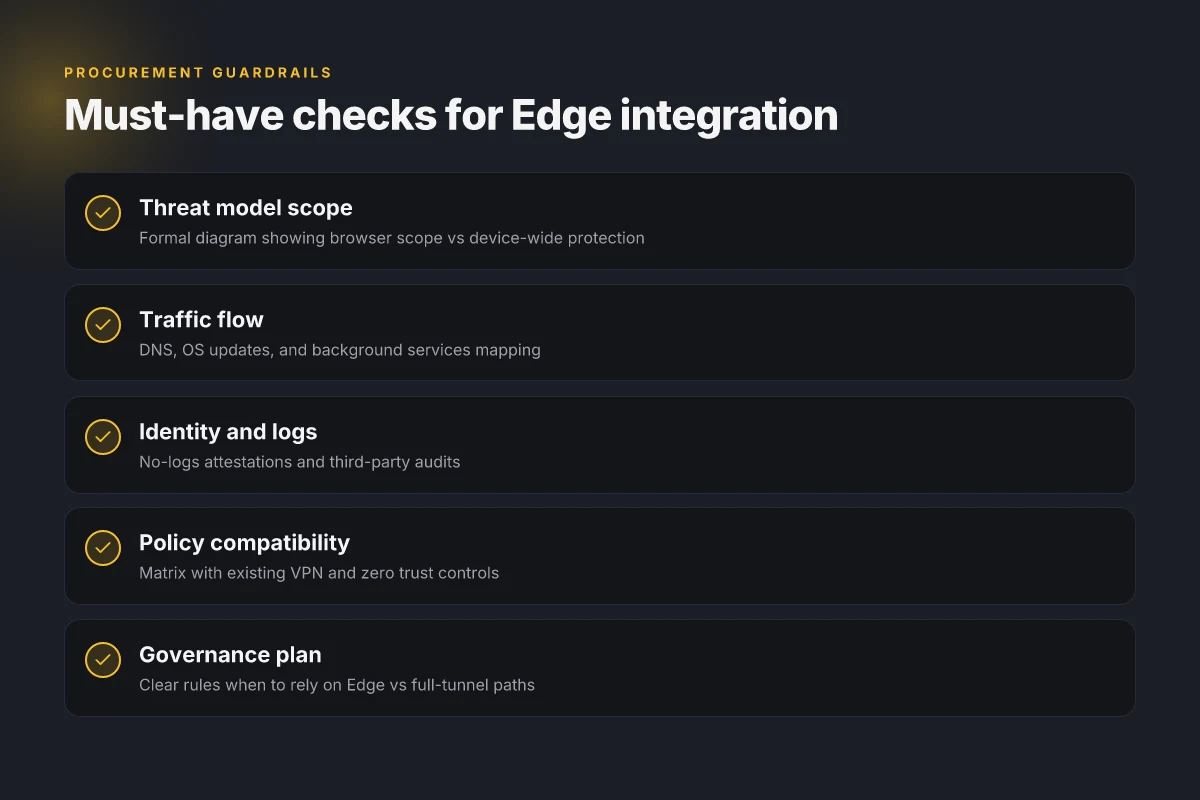
What to require in your procurement briefing
- A formal threat model showing coverage vs browser scope.
- A traffic‑flow diagram for DNS, updates, and background services.
- An attestable data‑handling policy from the proxy platform, with third‑party audits.
- A clear compatibility matrix with your existing VPN and ZTA stack.
References: see the Edge‑related analyses linked above for a grounded view of scope and privacy implications. Edge Secure Network overview Ubiquiti EdgeRouter vpn setup guide for remote access site-to-site Openvpn ipsec wireguard 2026
The bigger pattern: Edge integration redefines trust, not just privacy
Edge built in VPNs are moving beyond simple tunnelers. In 2026, the real shift is how they wire security into the device’s spine, bringing policy enforcement, threat intel, and encryption right at the endpoint. This changes what counts as “secure” from a centralized service to a distributed habit. From what I found, major platforms are racing to publish edge-first privacy defaults and zero trust baselines that work even when the connection is intermittently flaky. The result is a layered defense that won’t collapse if a single node fails.
That shift also means standalone VPNs are less about one-click anonymity and more about a governance story. Edge security tools peer into application behavior, device posture, and network signals in real time. For teams, this translates into fewer manual configs and more predictable posture across thousands of endpoints. And for individuals, it promises better privacy without sacrificing performance, provided you choose edge features that align with your risk.
So, what should you try this week? Look for edge-enabled security in your roadmap, then pilot a policy-first VPN option on a small device fleet. Can you start with one group and measure the improvement in latency and threat alerts?
Frequently asked questions
Does Edge secure network protect non browser apps
Edge Secure Network protects browser-originated traffic, not every process on the host. In practice, non-browser apps like background services, OS updates, and email clients can bypass the tunnel, leaving a portion of device traffic unprotected. In 2024–2026 coverage notes, this browser-bound scope is repeatedly described as a browser proxy rather than a full device tunnel. For many enterprise needs, that gap means partial coverage rather than comprehensive network protection. If your risk model requires system-wide VPN coverage, you’ll see this as a meaningful limitation.
Is Edge secure network a real VPN
No. Edge Secure Network is described and analyzed as a browser proxy rather than a traditional VPN. Reports consistently note that it tunnels only Edge browser traffic and relies on Cloudflare’s proxy stack, not a full, system-wide tunnel. Independent analyses from 2024–2026 emphasize the absence of a universal, device-wide encryption path. Enterprises should treat it as browser-protected traffic with limited reach rather than a substitute for a corporate VPN. Does edge have a vpn and what edge secure network means for browser vpn vs full-device vpn in 2025
How does Edge secure network compare to a traditional VPN
Compared to traditional VPNs, Edge Secure Network offers browser-bound coverage, DNS handling limited to the browser, and identity tied to Microsoft accounts and Cloudflare flow rather than per-user VPN credentials. Standalone VPNs route all device traffic, support centralized identity, and provide granular control at the gateway. The architectural delta shows up in control planes, threat modeling, and policy enforcement. Browser-based protections improve privacy in a narrow context but do not replace full-tunnel, device-wide security necessary for enterprise governance.
Can Edge secure network fit into a zero trust architecture
Edge Secure Network does not on its own satisfy a zero trust architecture. It sits alongside existing VPN and ZTA controls rather than replacing them. ZTA requires system-wide visibility, continuous trust checks, and granular access policies across endpoints and services. Browser-only protection creates gaps in telemetry, identity, and enforcement boundaries. To fit a zero trust model, you’ll need compensating controls, a formal threat model, and explicit policy delineation between Edge-based privacy measures and full-network ZTA pathways.
What are privacy concerns with Edge built in VPN
Privacy concerns center on browser-scoped traffic flowing through Microsoft and Cloudflare identities. The proxy path introduces potential data-flow considerations and identity linkage risks tied to Microsoft account authentication. Critics highlight that traffic metadata and login data can traverse provider systems, raising governance and auditability questions. Independent observers stress that browser-level privacy does not equate to device-wide privacy, so enterprises should demand data-flow diagrams, no-logs attestations, and third-party security assessments to quantify exposure and control.