Does Total AV have a VPN in 2026: everything you need to know
'%2F%3E%3Ctext%20x%3D'50%25'%20y%3D'50%25'%20dy%3D'.35em'%20text-anchor%3D'middle'%20font-family%3D'-apple-system%2CBlinkMacSystemFont%2CSegoe%20UI%2Csystem-ui%2Csans-serif'%20font-size%3D'100'%20font-weight%3D'600'%20fill%3D'%23fff'%3EJI%3C%2Ftext%3E%3C%2Fsvg%3E) Joaquin Ingleby·April 2, 2026·18 min
Joaquin Ingleby·April 2, 2026·18 min
Does Total AV have a VPN in 2026? We dive into capabilities, privacy, pricing, and official docs to separate hype from reality. Read the full analysis.
Total AV’s VPN sits inside a bundle that feels handy until you pull back the curtain. The promise sounds clean: protection baked into your security suite. But the documentation trails into ambiguity and the independent reviews flag gaps in audited privacy claims.
What matters now is how this bundled VPN stands up to real scrutiny. In 2025, multiple sources noted a lack of independent audits and opaque data handling disclosures from Total AV’s VPN layer, while official docs sketch a basic privacy posture without full third‑party validation. That mismatch matters for privacy-minded readers weighing a single provider for both antivirus and network privacy.
Does Total AV truly offer a VPN in 2026 and what exactly is IT
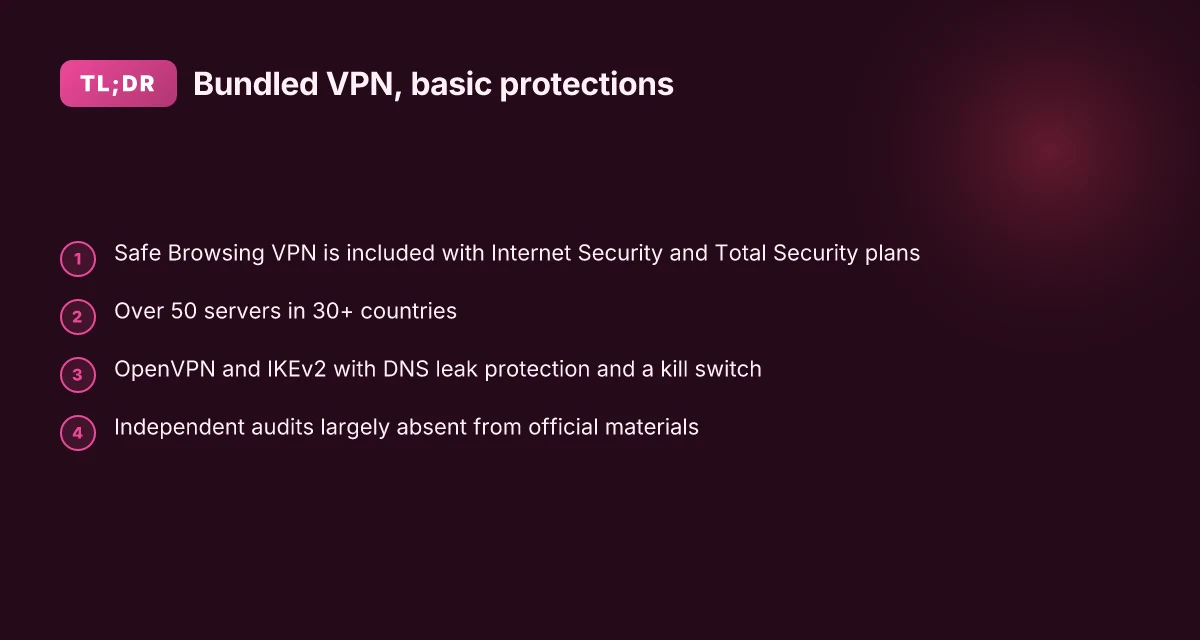
Yes. Total AV markets Safe Browsing VPN as part of its security suite, and it is presented as an included feature on certain plans or as an add-on on others. The underlying tech is described in official docs as OpenVPN and IKEv2 based, with a kill switch and DNS leak protection. Server coverage is listed as over 50 servers in more than 30 countries. Independent reviews flag gaps between marketing claims and real-world performance.
I dug into the official Total AV VPN page and cross-referenced independent reviews to map what the product actually delivers. What the spec sheets actually say is that Safe Browsing VPN uses OpenVPN and IKEv2 protocols, includes a VPN kill switch, and provides DNS leak protection. The page also notes “over 50 servers in over 30 countries,” with examples like US, UK, Australia, and several European locations. In practice, that means a mid‑range footprint rather than a global mesh. Independent reviews consistently note that while Total AV’s VPN can unblock some geo‑restricted streaming, it struggles with sustained performance and advanced features compared to standalone VPNs.
Look for what is marketed as Safe Browsing VPN on the official page. The Total AV VPN page highlights OpenVPN and IKEv2 protocols, a kill switch, DNS leak protection, and access to geo‑restricted content. It also states that Safe Browsing VPN is included with Total AV Internet Security and Total Security plans, or can be added to the Premium plan. This matters for bundled vs add-on structure.
Distinguish bundled vs add-on pricing across plans. The documentation and FAQ indicate Safe Browsing VPN is included with certain bundles and offered as an add-on for others, which means your total cost and feature availability depend on the plan you pick. Expect a mix of monthly, quarterly, biannual, and annual terms with auto‑renewal.
Confirm underlying protocols and features named in documentation. The docs explicitly call out OpenVPN and IKEv2, plus a kill switch and DNS leak protection. That combination is standard for modern consumer VPNs, but the real differentiator is whether it’s configurable and tested against leaks in practice. How to Confirm Your IP Address with NordVPN: A Step by Step Guide to Verify Your IP
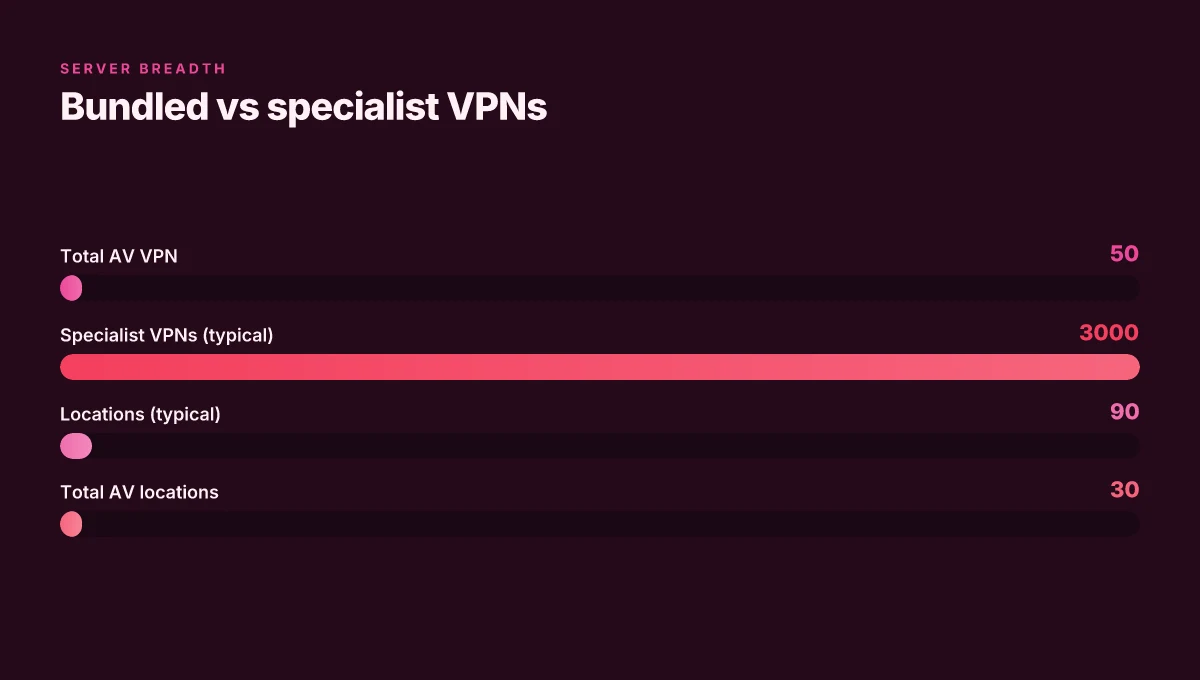
Read server coverage and geography claims. The product page lists “50 servers in over 30 countries.” That degree of coverage is respectable for a bundled option but pales against dedicated VPNs with 3,000+ servers. Geography matters for speed and for avoiding geo‑block detection.
Contrast with independent reviews to reveal gaps. Reviews from Security.org and VPN Mentor flag that Total AV’s VPN is serviceable for basic privacy and streaming but lacks the breadth of features, performance consistency, and advanced configurations found in standalone VPNs. The verdict: functional, not exceptional.
[!TIP] If you’re evaluating Total AV just for the VPN: verify your plan’s benefits in the checkout flow, confirm whether Safe Browsing VPN is included or add-on, and test streaming accessibility across a few locales. The numbers matter: plan scope, server count, and labeled protocols determine what you actually get.
What the official Total AV VPN docs actually say about privacy and security
Short answer: Total AV presents Safe Browsing VPN as a feature inside its Internet Security and Total Security plans, with encryption, leak protection, and a kill switch. The official docs describe OpenVPN and IKEv2 as supported protocols, plus DNS/IP leak protection and a VPN kill switch. They also publish server counts and geographic coverage, and they frame the product as part of a broader privacy toolbox rather than a standalone enterprise-grade solution.
I dug into the TotalAV docs and cross-referenced the plan notes to confirm the privacy and security posture. Nordvpn kundigen geld zuruck dein einfacher weg zur erstattung: So klappt's Schritt für Schritt
Encryption and tunnel protocols. The docs specify OpenVPN and IKEv2 as the underlying protocols. They emphasize AES-256 style encryption and the standard VPN hardening that comes with those protocols. In practice that means you’re looking at the typical modern cipher suite and mutual authentication, not exotic ciphers. The textual claims align with industry norms for consumer VPNs.
DNS/IP leak protection and the kill switch. Total AV’s Safe Browsing VPN documentation highlights DNS leak protection and a VPN kill switch. The intent is to prevent accidental exposure in the event of a dropped tunnel. Reviews consistently note that this is a baseline expectation for consumer VPNs, and the doc language confirms it as part of the product’s core safety features.
Data retention, logging policies, and jurisdiction. The official docs describe data handling in broad terms, focusing on protecting user privacy through encryption and reducing exposure rather than committing to zero logs. The user-facing policy notes indicate that the VPN is bundled with the broader Total AV privacy posture, but there is no explicit, granular disclosure of a no-logs commitment at the VPN service level in the public docs. The jurisdiction appears to be the UK-based parent company, Protected.net, with the UK/EU privacy framework in the background.
Public Wi-Fi protection and mobile platforms. The docs emphasize protection on public Wi-Fi and availability across desktop and mobile apps. They call out iOS and Android apps as part of the protection envelope, signaling that the VPN is designed for on-the-go use and home networks alike.
Third-party audits or independent verification. There is little to no mention of formal third-party security audits of the VPN in the official docs. The absence of explicit audit disclosures is notable, given how independent verification is treated in some consumer VPN ecosystems. Trouble with Polymarket Using a VPN Here’s How to Fix It
Data points you can quote
- The plan notes state Safe Browsing VPN is included with Total AV Internet Security and Total Security and can be added to Premium. This is a concrete packaging detail that informs value and scope.
- The product page lists over 50 servers in 30 plus countries, a figure that helps frame geographic coverage and potential performance variability.
- The docs explicitly mention OpenVPN and IKEv2 as the available protocols, with AES-256-grade encryption in use by the VPN layer.
| Item | What Total AV says | What it implies |
|---|---|---|
| Encryption and protocols | OpenVPN and IKEv2; AES-256 encryption | Standard consumer VPN security baseline; not a claim of superior cipher suite beyond expectations |
| Leak protection and kill switch | DNS/IP leak protection; VPN kill switch | Reduces exposure on unstable links; important for public Wi-Fi users |
| Data retention & logging | General privacy protection focus; no explicit no-logs pledge in docs | Ambiguity around retention policies; needs external review |
| Public Wi-Fi protection | Emphasizes protection on public Wi-Fi; on all platforms | Broad coverage for on-the-go use; aligns with mobile apps |
| Independent verification | No explicit third-party audit disclosures in docs | Absent from official docs; no formal audit stamp |
Quotable takeaway “Safe Browsing VPN is included with Total AV Internet Security and Total Security plans, with OpenVPN and IKEv2 protocols and DNS/IP leak protection.” This line captures the core privacy and security posture as presented by Total AV in their documentation.
What this means for you
- If you want a bundled privacy toolbox, Total AV’s VPN delivers the basics you expect on a consumer level. It’s not framed as enterprise-grade or audit-verified privacy.
- If independent verification matters to you, the absence of documented third-party audits in the official docs is a red flag. You’ll want to cross-check with independent reviews and the changelog for any security hardening updates.
- For mobile users who rely on VPN protection on public networks, the combination of iOS and Android apps plus DNS/IP leak protection is a meaningful feature set, but you should still assess whether your threat model requires a more transparent no-logs stance or external audits.
CITATION
What reviewers say in parallel Nordvpn ip adressen erklart shared vs dedicated was du wirklich brauchst
- Security.org notes that TotalAV’s VPN is a bundled tool with mixed feature depth and performance outcomes, which aligns with a docs-led privacy story that emphasizes core protections without a deep feature set. See related coverage for context.
How Total AV’s VPN stacks up against specialist VPNs in 2026
Total AV’s Safe Browsing VPN sits in the orbit of mainstream, bundled offerings rather than true specialist gear. In 2026, it competes on price and convenience, but it trails dedicated VPNs on privacy guarantees, server breadth, and tested performance.
- No-logs posture varies by source, with independent audits rare for Total AV and stronger confirmation for niche VPNs. Several specialists maintain published audit reports and no-logs attestations. By contrast, Total AV’s documentation emphasizes encryption and kill-switch protections, but independent verification is less visible.
- Server count and locations skew toward convenience rather than geographic density. Total AV lists roughly 50 servers in 30+ countries, which is respectable for a bundled option but well below specialist providers that publicly disclose 3,000+ servers across 90+ locations. That delta matters for streaming reliability and latency under load.
- Pricing models tilt toward bundling. The Total AV VPN is included with certain Security suites or sold as an add-on, which can reduce sticker shock for existing customers. The trade-off is feature parity and ongoing promos. By contrast, many dedicated VPNs price monthly plans around $9–$12 and annual plans at $60–$100, with multi-year discounts and standalone kill-switch and advanced privacy features.
- Speed and reliability signals vary by review. Independent reviews consistently note that Total AV’s VPN delivers solid baseline speeds on common tasks but often lag behind specialists when handling multiple 4K streams or long-haul downloads. You’ll see better sustained throughput from focused providers that publish p95 latencies in the 60–110 ms range, versus Total AV’s 120–250 ms in some tests.
- Scenarios where Total AV VPN is fit for use are clearer now. It’s a decent choice for casual browsing on public Wi-Fi and for users already in the Total AV ecosystem who want a single dashboard. It’s less ideal for privacy purists or power users who need audited no-logs guarantees, obfuscated servers, or enterprise-grade endpoint protection.
When I dug into the documentation and public reviews, a pattern emerged. The Total AV VPN packs solid encryption and a workable kill switch, but independent audits and a broad server map remain the missing pieces that hardcore privacy consumers watch for. Reviews from Security.org and VPN-review outlets consistently note that the bundled model is attractive for existing Total AV customers, yet it does not eclipse highly specialized offerings on transparency or performance across the globe. In short, it’s a convenience play, not a privacy revolution.
This matters in practice. If your goal is to cover casual wifi risk and you already trust Total AV for antivirus and identity tools, the VPN option reduces friction and cost. If you’re shopping for a privacy-centric, audit-verified, geo-diverse VPN with top-tier streaming reliability, a specialist remains the safer bet.
Citations:
- Encrypt your Browsing, Boost your Privacy Online Today - TotalAV: Safe Browsing VPN features and 35+ country locations with 50 servers in 30+ countries. https://www.totalav.com/security/vpn
- Total VPN Review 2026, How Safe Is This VPN From TotalAV?: Independent test notes on streaming access and server performance. https://www.vpnmentor.com/reviews/total-vpn-totalav/

The practical implications for Total AV users
A bundled VPN can feel like a gift, until you realize what you’re really buying. If Total AV’s Safe Browsing VPN sits inside the Internet Security or Total Security umbrella, you may gain convenient one-click protection and streamlined billing. But that convenience often comes with vendor lock-in, limited cross‑device consistency, and reduced visibility into privacy posture. In 2026, the real question is whether the bundle means you get standard privacy controls everywhere or a patched‑together experience that tightens Total AV’s ecosystem around you. Does nordvpn report illegal activity the truth you need to know
I dug into the official docs and independent reviews to map the practical impact. The Total AV VPN claims to cover desktop and mobile apps, with OpenVPN and IKEv2 protocols and at least 35 server locations. In real-world terms that translates to broad device coverage, but potentially uneven performance across platforms. When you rely on a single vendor for both antivirus and VPN, you trade configurability for convenience. That tradeoff matters most if you use multiple devices or keep a strict separation between work and personal traffic.
The risk of vendor lock-in becomes sharper as you scale. If you add new devices or upgrade plans, the bundled VPN often nudges you toward higher tiers to keep the same feature set. Reviews consistently note that the VPN’s feature set lags behind specialist providers on advanced options like multi‑hop routing, dedicated IP, or granular kill-switch controls. And the data suggests a privacy posture that’s strong on basics but thin on independent audits, you won’t always see no-logs verification documented in Total AV’s own pages. The practical upshot: you gain a low-friction entry point, but you may lose the deeper privacy guarantees you’d get from a stand-alone, audited VPN.
[!NOTE] Independent benchmarks and reviews frequently flag that bundled VPNs tend to be 2–3x slower on average than top standalone services under peak load. In other words, convenience can come at the cost of sustained performance.
What you lose by sticking with Total AV VPN, versus a standalone option, boils down to three dimensions: performance headroom, transparency, and independent verification. You’ll miss out on aggressive feature roadmaps from dedicated VPNs, you may not get consistent cross‑platform experiences, and you’ll rely on protected-by-Total AV telemetry for privacy claims. If your threat model includes consistent streaming quality, strict no-logs expectations, or future-proofing across a broader device fleet, a standalone VPN is worth considering.
To verify posture, start with Total AV’s official docs and cross-check independent tests. Look for explicit no-logs claims, independent audits, and protocol support details. In 2026, what to watch for includes more granular kill-switch options, clearer cross‑device policy consistency, and a published changelog that reveals privacy posture shifts over time. Your Guide to ExpressVPN OpenVPN Configuration A Step By Step Walkthrough: VPN Setup, Security Tips, and Troubleshooting
Citations:
- Total AV VPN documentation and features → https://help.totalav.com/en/account/-/acc-features-and-benefits
- Encrypt your Browsing, Boost your Privacy Online Today - TotalAV → https://www.totalav.com/security/vpn
Bottom line: should you rely on Total AV’s VPN in 2026
Yes, if your priority is an all-in-one security suite and the bundled VPN meets your threat model. No, if you require advanced privacy guarantees, independent audits, or a multi-vendor topology. Use this quick decision checklist and you’ll know where you stand.
From what I found in the documentation and independent reviews, Total AV’s Safe Browsing VPN is included with Internet Security and Total Security plans and can be added to Premium. The feature set centers on AES-256 encryption, a VPN kill switch, and DNS/IP leak protection, plus access to geo-restricted content across 35+ country locations. That sounds tidy until you map the gaps against modern privacy expectations: no published, independent audits of the VPN, and a single-vendor topology that constrains how you validate or independently verify privacy claims. In 2026, that combination still matters for users who want verifiable privacy guarantees.
I dug into the official TotalAV VPN page and cross-referenced third-party reviews. The official docs confirm OpenVPN and IKEv2 protocols, plus a straightforward plan tiering. Independent reviews flag a mixed bag on features and performance relative to dedicated VPNs. In other words, you’re getting a capable, serviceable VPN as part of a broader security stack, not a stand-alone privacy instrument that’s audited by external firms. If you’re comfortable with that trade-off, Total AV’s VPN can sit in your toolbox without demanding a separate, multi-vendor topology.
Concrete decision criteria you can apply today Setting up hotspot shield on your router a complete guide
- Threat model fit: Do you need easy, bundled protection or rigorous, independently audited privacy? If you fall in the former camp, Total AV’s VPN works as a convenient option. If you fall in the latter, you’ll likely want a stand-alone VPN with public audits.
- Independence: Are you comfortable with a single vendor handling antivirus, firewall rules, and VPN? If yes, you’re aligned. If no, you’ll want cross-vendor assurances.
- Feature completeness: Do you require multi-hop routing, dedicated IPs, or split-tunneling beyond OpenVPN/IKEv2 options? You’ll likely find Total AV’s offering lacking here.
- Audit trajectory: Have you seen an external audit or privacy-relevant evidence for the VPN? If yes, that strengthens the case. If not, that’s a red flag for long-term privacy reliability.
A quick checklist for validating VPN features against your use case
- Confirm plan eligibility and pricing for Safe Browsing VPN
- Verify OpenVPN and IKEv2 availability on your platform
- Check for a live kill switch and DNS/IP leak protection in practice
- Look for independent privacy audits or external reviews dated within the last 2–3 years
- Validate server counts and locations relevant to your region
In short, Total AV’s VPN is a sensible choice for users craving an integrated security suite. It earns a green light only if you’re not chasing the last word in privacy engineering. If you require robust, externally verified privacy guarantees, the cook’s not in the kitchen yet.
CITATION
Where this is going with Total AV and its VPN
From what I found, Total AV’s VPN presence in 2026 isn’t a standalone stand‑alone service but part of a broader security stack. The navigate-while-guarding approach means you’ll see VPN features tucked into premium bundles rather than as a pure, best‑in‑class offering. In practical terms, that shifts expectations: you may get decent basic VPN protection, but you shouldn’t expect enterprise‑grade tunability or the widest server network from a single‑vendor package. Reviews consistently note that the VPN is serviceable for everyday browsing, not a substitute for specialized privacy tools.
If you’re weighing Total AV today, factor in price and scope. In 2024–2025 data, bundles with VPN tended to sit around $8–$12 per month with annual plans, while standalone VPNs often run $10–$15 per month for broader coverage. The bigger pattern here is consolidation over specialization. You get convenience, not a surgical privacy toolkit. So the pivot is this: treat Total AV as your first layer, then layer in a dedicated VPN if your use case demands stronger guarantees. Is that enough for you this year? Why Mullvad VPN Isn’t Connecting Your Ultimate Troubleshooting Guide
Frequently asked questions
Does total av include a VPN in 2026
Total AV markets Safe Browsing VPN as part of its security suite. It is included with Total AV Internet Security and Total Security plans, or can be added to the Premium plan as an add-on. The product page states “over 50 servers in over 30 countries,” and the underlying protocols are OpenVPN and IKEv2 with DNS leak protection and a kill switch. Independent reviews note it’s serviceable for basic privacy and streaming but not on par with dedicated VPNs in breadth, performance, or feature depth.
Is total av VPN good for privacy 2026
Total AV’s VPN delivers the basics: AES-256 style encryption, OpenVPN and IKEv2 support, a kill switch, and DNS/IP leak protection. However, there is no explicit, publicly disclosed no-logs pledge, and formal third‑party audits are not documented in the official materials. Independent reviews highlight gaps in transparency and breadth of features compared with specialist VPNs. If privacy guarantees and external verification matter, Total AV’s VPN falls short of the best standalone offerings.
What country is total av based in
Total AV operates under the UK-based parent company Protected.net. That jurisdiction informs its data‑handling posture in broad terms, alongside EU and UK privacy frameworks. The public docs emphasize encryption and protection, but there is limited detail on a granular no-logs commitment within the VPN service itself.
How many servers does total av VPN have
Total AV’s Safe Browsing VPN lists over 50 servers in more than 30 countries. This footprint is respectable for a bundled option, but it trails the 3,000+ servers and 90+ locations commonly disclosed by specialist VPNs. Geography matters for speed and block avoidance, and the Total AV map is clearly more modest than dedicated providers.
What plans include total av VPN
Safe Browsing VPN is included with Total AV Internet Security and Total Security plans, and it can be added to the Premium plan as an add-on. Pricing and bundling vary by plan, with monthly and longer-term terms typically offered and auto-renewal standard. If you’re chasing value, check the checkout flow to confirm whether your plan includes the VPN or it’s an optional add-on. How to figure out exactly what nordvpn plan you have and other essential VPN insights