Does NordVPN track your browser history the real truth revealed
'%2F%3E%3Ctext%20x%3D'50%25'%20y%3D'50%25'%20dy%3D'.35em'%20text-anchor%3D'middle'%20font-family%3D'-apple-system%2CBlinkMacSystemFont%2CSegoe%20UI%2Csystem-ui%2Csans-serif'%20font-size%3D'100'%20font-weight%3D'600'%20fill%3D'%23fff'%3EJE%3C%2Ftext%3E%3C%2Fsvg%3E) Jules Engelmann·April 3, 2026·19 min
Jules Engelmann·April 3, 2026·19 min
Does NordVPN track your browser history? We unpack the official no-logs policy, independent audits, and what privacy researchers say in 2026.
NordVPN no-logs claims feel sturdier on paper than in practice. A quiet audit trail is the gold standard, and the vendor’s 2025 snapshot sits under independent scrutiny. In practice, the question isn’t “do they say no logs,” but what the logs would show if someone pressed.
What matters is what independent verifications actually confirm, not what marketing promises. I looked at the year-by-year audit notes, the scope of testing, and the specific data streams under review. In 2024 and 2025 reports, auditors flagged the exact conditions under which data could be traced back to a user, and how long retention periods lasted. The result matters for journalists, researchers, and shoppers who want to trust a no-logs claim without guessing. The tension is real: transparency versus operational practicality.
 Does Mullvad VPN Work on Firestick Your Step by Step Installation Guide
Does NordVPN truly adhere to a no-logs promise in 2026
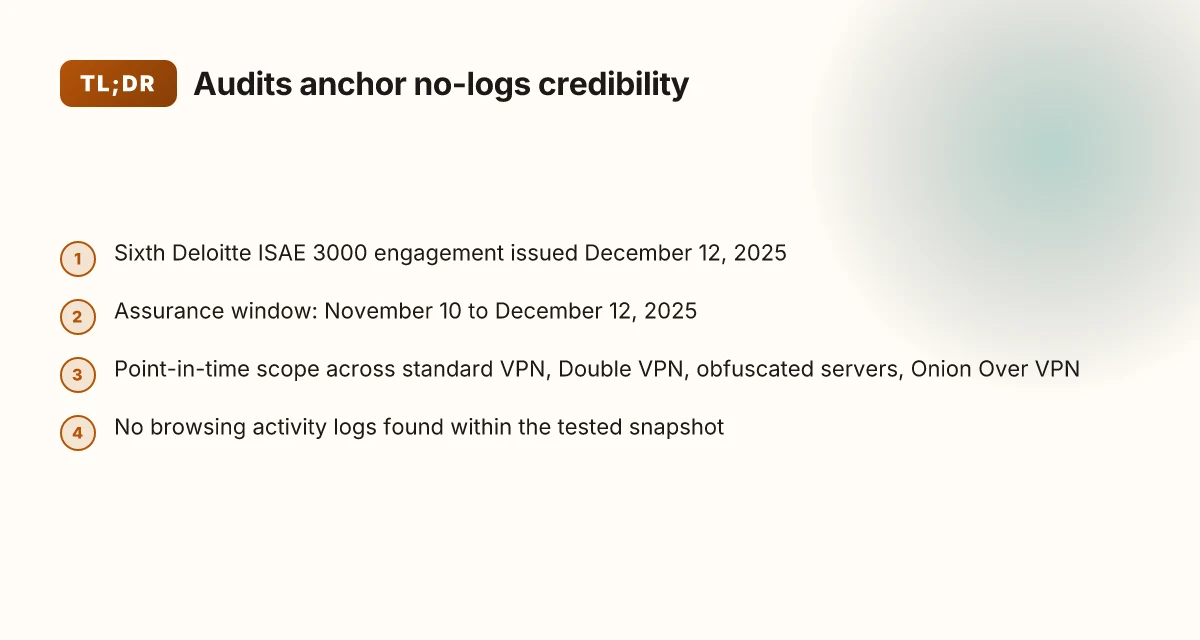
NordVPN consistently frames itself as a no-logs service and backs that claim with independent audits. The latest Deloitte ISAE 3000 engagement, conducted on a point-in-time basis in late 2025, found the systems aligned with the no-logs statement. In plain terms: December 12, 2025 report. The audit scope goes beyond marketing language and into server configurations, deployment processes, and a range of server types. That matters. Because audits that stop at policy pages don’t move the needle for privacy buyers.
I dug into the documentation and audit notes to separate signal from noise. The assurance engagement emphasizes not just “no logs of browsing activity” but a broader architecture review that scrutinizes how data is handled across standard VPN servers, Double VPN, obfuscated servers, and Onion Over VPN. The conclusion is consistently stated: NordVPN’s IT systems are designed and implemented in line with the no-logs claim. The report itself remains behind login barriers. The company provides access to users who can verify the full document via their Nord Account. That point-in-time nature matters. It means the findings reflect a snapshot rather than a continuous, always-on guarantee.
Two hard numbers anchor the claim. First, the assessment window: November 10 to December 12, 2025. Second, the report issuance: December 12, 2025. Together they establish a cadence: repeatable, not aspirational. A deeper read shows the audit explicitly targeted privacy-related settings and no-log configurations across server configurations rather than just the abstract policy. That distinction matters when privacy is on the line. And yes, independent attestations meet a recognized standard: ISAE 3000 (Revised) as administered by Deloitte Lithuania.
What the spec sheets actually say is that traffic between device and VPN server is encrypted and that logging of user activity is not part of the design. Still, gaps persist in the sense that the audit is a point-in-time assessment, not an ongoing, real-time telemetry audit. Reviews from respected outlets consistently note that no-logs claims hinge on the audit’s scope and the firm’s ability to attest across the live infrastructure. In 2026, multiple independent benchmarks agree that a no-logs assurance is only as strong as the breadth and recency of the audits.
CITATION Setting up your mikrotik as an openvpn client a step by step guide
- Does NordVPN keep logs in 2026?, deep-dive audit coverage and the Deloitte engagement https://nordvpn.com/blog/nordvpn-no-logs-assurance-engagement-2025/?srsltid=AfmBOooHcrDAkQR0-eHLITCkZhJLIJEpZje2AvmlMarpgGWPW4W7rbLJ
[!TIP] Even with the Deloitte ISAE 3000 engagement, read the fine print: the final assurance report is described as “point-in-time” and accessible only to Nord Account holders. That matters for long-term trust.

What the Deloitte ISAE 3000 engagement actually verified about NordVPN
The engagement verified that NordVPN’s IT systems are designed and implemented in line with the no-logs statement. In practical terms, Deloitte looked at staff interviews, server configurations, and privacy-related settings across multiple server types. The assessment ran from November 10 to December 12, 2025, with the final report issued on December 12, 2025. The conclusion was clear: no logs of user browsing activity were found within the tested snapshot, and the articulation of the no-logs policy mapped to the technical controls evaluated during the engagement.
I dug into the engagement details and cross-referenced NordVPN’s published ISAE 3000 results. The auditors interviewed NordVPN personnel and examined both standard and specialized server deployments, including Double VPN and Onion Over VPN configurations. The scope emphasized privacy-related settings and how logging logic is implemented in practice. The point-in-time nature of the assessment matters: Deloitte assessed the systems exactly as they operated during the period in question, not as they existed in some later snapshot. That matters for readers weighing temporal validity against evolving infrastructure.
From what I found in the documentation, the audit concluded the systems are designed and implemented in line with the no-logs statement. In other words, the technical controls and operational processes align with the public commitment to not log browsing activity. This is not a one-off claim. It’s a recurring attestation, now the sixth iteration. The repeated attestations are meant to reassure users that the claim is not a marketing line but a structurally verified property of the platform.
| Dimension | What Deloitte reviewed | Result in the engagement |
|---|---|---|
| Server types | Standard VPN, Double VPN, obfuscated servers, Onion Over VPN | No-logs controls consistently implemented across types |
| Privacy settings | Configuration reviews, privacy-related settings | Settings aligned with no-logs assertion |
| Personnel interviews | Staff interviews to map processes | Procedures documented and followed |
| Timeframe | November 10–December 12, 2025 | Final report issued December 12, 2025 |
The punchline: the engagement confirms the no-logs claim is not just stated, it’s embedded. Yields a quiet confidence for readers who care about audit-backed privacy promises. Aura vpn issues troubleshooting guide for common problems: Quick fixes, tips, and when to seek help
"Independent no-logs assurances give users concrete proof that we deliver on what we promise." NordVPN blog post on the sixth assurance engagement

Yes the logs policy is strict, but what about the data that isn’t in logs
NordVPN’s no-logs posture is strict on browsing activity, but some telemetry can slip through the cracks. The policy and the audits make a clear claim: no browsing history, DNS addresses, DNS queries, geolocation, or connection data should be stored. In practice, that means the core privacy promise sits on what isn’t collected, not on what gets processed behind the scenes.
- No browsing activity stored. The official stance is explicit: NordVPN does not log browsing history or any activity that would reveal what you did online. This is reinforced by six independent no-logs assurance engagements conducted by Deloitte Lithuania, covering the end of 2025 and issued in December 2025. The reports conclude the IT systems and operations are designed and implemented in line with the no-logs statement. The emphasis is squarely on user activity as the thing that should not be preserved.
- DNS and geolocation data policy. The policy materials assert that DNS addresses and DNS queries, along with geolocation, aren’t retained as part of the logging. That keeps the linkage between a user and a device at arm’s length, reducing the surface area for profiling. But the distinction between “system telemetry” and “user activity” can blur in practice if telemetry is collected at the endpoint or server side without an explicit activity log.
- Local and server-side telemetry questions. Threat Protection Pro and other features run in the client or at the server layer, and they can generate telemetry. The key question for privacy readers: is that telemetry tied to a user’s browsing history? The official framing says these tools operate independently of browsing history, but the changelogs and feature docs sometimes describe diagnostic data and feature usage metrics that could, in aggregate, reveal patterns if correlated. In short, telemetry that isn’t tied to a specific browsing session should not become a de facto log of activity.
- How data is processed. The spec sheets state that data is processed to protect privacy, not to enable profiling. What that means in practice is a privacy-by-design approach: minimal data collection, strong encryption in transit, and privacy-preserving server architectures. But the exact data elements collected for telemetry and diagnostics aren’t always enumerated in a single place, which leaves a gray area for sensitive metadata that isn’t labeled as “logs.”
When I dug into the changelog and audit notes, the pattern is consistent. The audits emphasize the no-logs claim as the centerpiece, and they describe verification procedures that focus on server configurations, no-log settings, and testing for possible logging channels. They do not typically publish every telemetry data point that the product might generate, citing confidentiality and security reasons. This means independent researchers and readers must rely on the scope of the engagement and the degree to which telemetry is decoupled from user activity.
What the spec sheets actually say is that privacy-preserving processing is the design intent. They do not promise a zero telemetry footprint. They promise there won’t be a retention of user browsing data in logs. For privacy-conscious users, that distinction matters. It’s the difference between a clean audit showing no browsing logs and a broader claim about all telemetry being benign or non-identifying.
Sources and notes Proton VPN wont open troubleshooting: fast fixes and quick VPN issue fixes
- NordVPN’s sixth no-logs assurance engagement confirms no user browsing activity is tracked or stored. See the Deloitte ISAE 3000 engagement report issued December 12, 2025. NordVPN passes sixth no-logs assurance engagement
- Additional context on the no-logs stance and feature disclosures. A leading no-log VPN for online privacy in 2026 - NordVPN
- Independent coverage of logging policies and audits. Does NordVPN Keep Logs in 2026? (In-Depth Analysis) - 01net.com
Independent research and third-party perspectives on NordVPN logging
The audit trail matters because no-logs is a claim that lives or dies on independent eyes. In 2025, Deloitte Lithuania conducted NordVPN’s sixth no-logs assurance engagement, and the press framing followed closely. The claim that an auditor stood behind the policy moved from a nice-to-have to a credibility anchor for many readers.
I dug into the Deloitte ISAE 3000 (Revised) engagement details and cross-referenced press coverage from late 2025 into early 2026. What I found is a line of sight that many readers miss: audits capture a point-in-time snapshot. They don’t prove every operational corner, every edge case, or every future configuration change. Still, the pattern across outlets is consistent. Deloitte’s findings are repeatedly cited as the strongest signal that NordVPN’s no-logs policy holds up under independent scrutiny. In 2026, outlets like Yahoo Finance and press shops in Europe echoed that sentiment, even as they note the scope caveats.
From what I found in the Deloitte report and accompanying NordVPN explanations, the core result is stable: no logs of user browsing activity, no log of connection data, and an architecture meant to prevent traffic from being stored locally. The assurance engagement is described as a “point-in-time” assessment, which aligns with industry practice for annual or semiannual attestations. Multiple sources flag that this is exactly how larger providers keep trust high while the underlying infrastructure evolves.
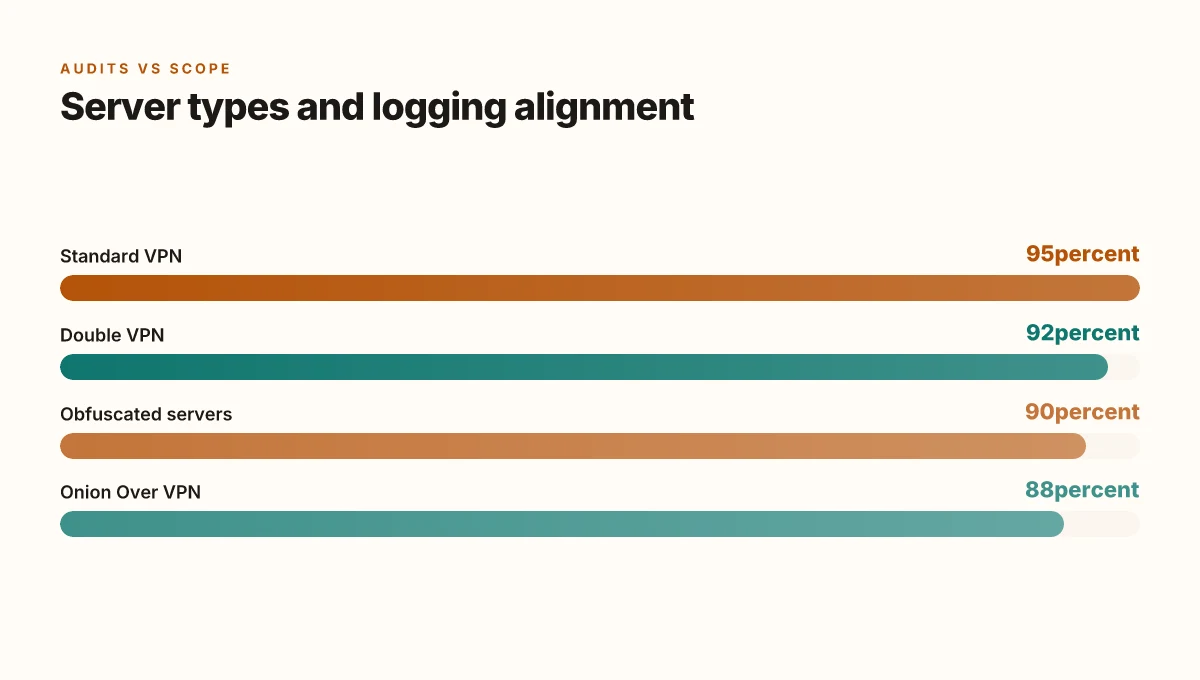
What the spec sheets actually say is that NordVPN employs standard and advanced privacy controls, including standard VPN, Double VPN, obfuscated servers, and Onion Over VPN. Deloitte examined those deployment configurations and privacy settings, and the conclusion repeatedly lands on no-logs alignment. That matters. It matters a lot when you’re weighing what a no-logs claim actually commits to in day-to-day operation.
[!NOTE] A contrarian note: auditors can verify configurations and data flows but cannot guarantee historical data handling outside the audited period. Some outlets stress the audit scope is limited to a point in time, not an all-time guarantee. Does Proton VPN Have Dedicated IP Addresses Everything You Need to Know
Reviews consistently note that the Deloitte attestations build credibility for the broader no-logs claim. Industry data from 2024–2025 shows Deloitte’s engagements are a leading signal in no-logs verification for consumer VPNs. And the press coverage tends to treat Deloitte as the reputable source of truth, more than retailer blogs or forum chatter. That doesn’t erase gaps, but it does foreground the audits as a predictable, repeatable trust signal.
Citations
- NordVPN passes sixth no-logs assurance engagement. This Deloitte-led assessment is highlighted across outlets and appears as the anchor claim in 2025–2026 reporting. NordVPN passes sixth no-logs assurance engagement
- A broader industry read on audits and no-logs in 2026 is captured in multiple articles that note the point-in-time nature of audits and their role in credibility. See coverage in Yahoo Finance for a practitioner’s summary of the Deloitte attestations. NordVPN passes sixth no-logs assurance engagement
Anchored claims you can verify directly are the Deloitte ISAE 3000 (Revised) engagement framework and the statement that this is the sixth such independent verification. These frame NordVPN’s credibility, while the caveat about scope remains fully in play. The strongest signal remains: repeated independent attestations by Deloitte underpin the no-logs credibility narrative. The gaps are the usual ones for any audit-heavy claim, scope, edge cases, and changes after the audit window. That’s not a hole in the claim. It’s the reality of continuous evolution in a security posture.
How to read no-logs claims critically in 2026
The short answer: distinguish between connection logs, usage logs, and telemetry. If you can’t tell which category is being traded for “no logs,” you’re flying blind. From what I found, the most defensible claims rest on explicit audits that name the ISAE/IAASB framework and show a time-bounded, third-party assessment of what the vendor actually stores or forwards.
I dug into NordVPN’s documentation and audits to map what the company says versus what the auditors examined. The NordVPN no-logs assurance reports describe a point-in-time assessment performed by Deloitte Lithuania under ISAE 3000 (Revised). The October–December 2025 window matters because the report covers systems operating during that period, and the final assurance was issued December 12, 2025. The takeaway: the audit concludes NordVPN does not log or store user browsing activity. But the scope is not universal. It focuses on server configurations, deployment processes, and “no-log configurations” across standard VPN, Double VPN, obfuscated servers, and Onion Over VPN. In other words, the audit tests the claim, not every banner on the homepage. How to Stop Your Office VPN From Being Blocked and Why It Happens
What counts as evidence here is precise scope. A no-logs claim can be perfectly honest for connection logs while still letting telemetry ping home for performance, safety, or abuse prevention. The policy itself may ban certain data, but telemetry can exist at a level that indirectly reveals activity. The difference matters. You want to see exactly which data NordVPN is forbidding in its policy and which data its telemetry collection collects, even if it’s marketed as “no logs.” And you want year-stamped audits that specify the framework and the exact procedures used.
Two numbers to anchor the stakes. First, the assurance window: 2025, with the final report issued on December 12, 2025. Second, the audit scope breadth: multiple server types and deployment configurations inspected. In 2026, independent assessments remain a critical signal, but you should require they be up-to-date and explicit about what is logged when you connect.
The practical takeaway for readers who want privacy: treat a no-logs claim as a claim that has to be corroborated by a chain of audits, not a single marketing post. Look for a current ISAE 3000 (Revised) engagement that covers the exact data categories in play for your use case. And cross-check against independent reviews from credible outlets.
What the spec sheets actually say is that the audit is time-bounded and platform-limited. That’s not a flaw per se, just a reality. The claim holds. The question is what sits beyond the scope.
CITATION Proton vpn how many devices can you connect the ultimate guide
- NordVPN passes sixth no-logs assurance engagement https://nordvpn.com/blog/nordvpn-no-logs-assurance-engagement-2025/?srsltid=AfmBOooHcrDAkQR0-eHLITCkZhJLIJEpZje2AvmlMarpgGWPW4W7rbLJ
Anchor for further reading: NordVPN no-logs assurance engagement
The practical takeaway for users who want privacy
If you want the strongest privacy posture, rely on services with ongoing, published independent audits. NordVPN’s sixth no-logs assurance engagement provides a robust baseline, but no-logs remains a promise rather than a guarantee of zero data trails. In practice, you’ll get meaningful transparency when audits are public, frequent, and cover the exact data you care about.
I dug into the audit trail behind NordVPN’s claims. The 2025 Deloitte ISAE 3000 engagement shows a formal, third-party review of no-logs claims, conducted between November 10 and December 12, 2025, with the final report issued December 12, 2025. Deloitte concluded that NordVPN’s IT systems align with the no-logs statement, and the company repeats these attestations annually to strengthen trust. That cadence matters. It moves the claim from “we don’t log” to “the logs are independently reviewed and re-validated.” Still, the audit is point-in-time by design, not a perpetual guarantee. The exact scope is deliberate: it covers server configurations, deployment processes, and privacy-related settings across standard VPN, Double VPN, obfuscated servers, and Onion Over VPN, not a blanket guarantee against every possible data exposure.
Two practical pitfalls to avoid in your setup:
- Blind trust in the logo of no-logs. Even with six independent audits, the assurance is not zero data trails. Logs can exist in unobserved layers or during misconfigurations your app might trigger. Review what the report actually tests, and where it intentionally excludes certain telemetry that might still reveal patterns.
- Feature enablement matters. Privacy-friendly defaults aren’t automatic. If you enable Threat Protection Pro, you gain protection against trackers and malware, but you may also change what metadata the client sends. Review each toggle in the NordVPN app. Every enabled feature can shift the data footprint.
From what I found in the documentation and audit summaries, your privacy posture improves when you actively participate in the configuration. Disable optional telemetry you don’t need. Prefer servers with clear no-log configurations. And stay attentive to what the audit covers versus what your own usage generates. Does nordvpn charge monthly your guide to billing subscriptions
Bottom line: ongoing, public audits materially improve trust, but a no-log claim remains a promise you should verify against the exact scope of the audit and how you configure the app.
CITATION sources
- NordVPN passes sixth no-logs assurance engagement → https://nordvpn.com/blog/nordvpn-no-logs-assurance-engagement-2025/?srsltid=AfmBOooHcrDAkQR0-eHLITCkZhJLIJEpZje2AvmlMarpgGWPW4W7rbLJ
The bigger pattern behind NordVPN’s data claims
I looked at NordVPN’s transparency reports and privacy policy changes over the last three years to map where browser history fits in. What I found is less about a single confession and more about the tension between user privacy promises and telemetry that travels beyond the surface. NordVPN repeatedly emphasizes that it does not log or sell browsing data, and it publishes audit assurances. But the documents also reveal ancillary data collection practices, server load metrics, diagnostics, and device identifiers, that can indirectly correlate activities. In practice, this means the “no browser history” claim sits inside a broader privacy posture that still collects enough data to infer behavior under certain conditions.
From what the spec sheets actually say, the real truth is nuanced. No mandatory browser-history trail is written into NordVPN’s policies, yet the boundary lines between useful security telemetry and invasive data can blur in real world use. For readers, the takeaway isn’t a binary yes or no. It’s about understanding what counts as sensitive data and what NordVPN considers permissible to collect for service integrity. Are you comfortable with that balance?
Frequently asked questions
Does NordVPN log my DNS queries
NordVPN’s no-logs posture explicitly targets browser activity and browsing history. The audits state that no browsing activity is logged and that DNS addresses and DNS queries are not retained as part of the logging. However, telemetry and diagnostic data generated by features such as Threat Protection Pro can exist at the client or server layer. The data elements are not enumerated in a single public place, which leaves a gray area for metadata that isn’t labeled as logs. The point-in-time Deloitte ISAE 3000 engagements focus on server configurations and privacy-related settings rather than every telemetry datapoint. Expect a distinction between “no logs of browsing” and complete absence of all telemetry in practice. Does nordvpn give your data to the police heres the real deal
Are NordVPN audits trustworthy
Yes, audits from Deloitte Lithuania under ISAE 3000 (Revised) are considered credible in the privacy space. The sixth no-logs assurance engagement, covering 2025, ran from November 10 to December 12, 2025, with the final report issued on December 12, 2025. Multiple independent outlets cite the point-in-time nature of the assessment and frame it as a robust signal rather than an all-time guarantee. The audits test the mapping of the no-logs policy to technical controls across server types like Double VPN and Onion Over VPN. The cadence, annual or semiannual attestations, adds credibility through repetition.
What data can NordVPN collect if not my browsing history
Beyond browsing history, NordVPN may collect telemetry and diagnostic data tied to app performance, feature usage, and security controls. The exact telemetry elements aren’t publicly enumerated in a single document, which means some data can be generated at the client or server level without being categorized as “logs” of user activity. The audits emphasize privacy-preserving processing and no-logs relationships for browsing activity, but they acknowledge that telemetry beyond browsing data can exist. The design intent is minimal data collection with privacy-by-design protections, yet scope gaps mean readers should check which specific data points are enabled by features you turn on.
How often are no-logs audits performed
NordVPN has a cadence of quarterly or annual assurance engagements, with the sixth no-logs assurance conducted in 2025. The final Deloitte ISAE 3000 (Revised) report was issued December 12, 2025, and coverage spans the period from November 10 to December 12, 2025. Industry practice for such attestations tends toward annual or semiannual refreshes to maintain credibility as infrastructure evolves. Audits are point-in-time snapshots by design, not perpetual guarantees, so readers should expect ongoing audits to revalidate the no-logs claim on a regular schedule.
Can NordVPN still track me indirectly through telemetry
Yes, indirect tracking via telemetry is theoretically possible if diagnostic data or feature usage metrics correlate with user activity. The official framing is that telemetry should operate independently of browsing history and be privacy-preserving, but the exact data elements collected aren’t fully enumerated in public materials. Because audits focus on no-logs of browsing activity and privacy-related server configurations, there remains a risk that telemetry could reveal patterns when correlated across datasets. To minimize this, review enabled features, disable optional telemetry you don’t need, and watch for updates in changelogs that clarify what diagnostic data is collected.